
Showing posts with label hss125. Show all posts
Showing posts with label hss125. Show all posts
02 October 2009
college park : let loose
today in hss105, i turned the students loose to do a comparison of the college park neighborhood based on our group assessment of college hill. after the experience of a two week settling into period in the college hill neighborhood, it is my hope that the students will find much to discuss in their presentations on 6 october.

01 October 2009
125 presentations : images of empire
for this whole week in hss125, students have been delivering their topics to their peers for assessment and sharing. certainly every individual did well, and there will be a follow up post or two linking to their work....if i can get that work completed. i may come back and offer some commentary here after i've put some thoughts together for them.
25 September 2009
america guided by wisdom
 http://www.bestpriceart.com/painting/?pid=5391
in hss125 today, i presented "visualizing empire," a presentation that the wonderful kim martin and i did for a conference three years ago. using genre painting, we frmed architecture as a trope within the works to help understand notions of eastern-ness and western-ness in the early republic....with polarities between civilized and wilderness, order and chaos, etc. students seemed most to resonate with thomas cole's "course of empire" series....moving from the "savage state" to the "pastoral or arcadian state" to the "consummation of empire" to "destruction" and finally to "desolation." with each of these works in a series, cole depicts a cyclical view of the world, periodizing history and tending to compartmentalize each state into a discrete phase through which each civilization passes (reference here the later work of frederick jackson turner and the advance of the american frontier). the point of the presentation, though, is the blended landscapes with elements of the two visions of the world...not either/or but both/and.
17 September 2009
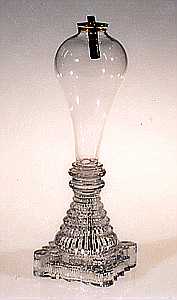
presentation workshop : the oil lamp example
 http://www.museum.state.il.us/exhibits/athome/1800/objects/largejpgs/whaleoillamp.jpg
as students conclude the first segment of hss125, they will be analyzing a series of artifacts from the period 1750-1850. today in class, we worked together using an oil lamp and created a presentation to help them see that visual media can actually WORK WITH the topic to help underscore central themes and issues. by developing a three point outline, students reinforced salient concepts using this example...and will thus turn their attention to their own specific projects.
here's what we dreamed up:
introduction
decoration/form
lower/upper parts
rough/smooth
pyramid/light bulb
erotic shape
hourglass shape/waist
knob/catch fingers
clear glass material
transparency/see oil
smooth/fragile
provide light
cold/hot to the touch
use/context
parlor…idea of darkness
servants/served
compare/contrast to other oil lamps
whale oil industry
sperm whales killed in great quantity
pacific ocean focused
pass out of fashion/sustainability
conclusion
and from there, we drew up slides and worked up some visuals...i've put together a demonstration slide that looks like this...

and here's the whiteboard in the room with some of our scribbles on it...

not bad for less than an hour's brainstorm.
16 September 2009
the great revolutionary object round up
the u.s.s. constitution
whiskey
slave shackles
the liberty bell
mt. vernon
a federal-style fireplace surround
the franklin printing press
moveable parts from both a gun + a gin
the ocracoke lighthouse
what do these things have in common? they represent objects selected by students and vetted by peers for material analysis in the hss125. stay tuned for the results of this work.
12 September 2009
grids + diagonals
 i was struck, particularly today, that the notion of shaping space, whether one looks at the historical record and the ideas pierre l'enfant penned for washington, or the seemingly haphazard plan for the campus of the university, that several universal principles hold. it seems that the strong idea of a grid can be seen in both physical environments....but in shaping the quad, clearly its designers harkened back to jefferson's sense of space and place as he developed the lawn at the university if virginia. interestingly, jefferson also proposed a similar organization for the plan of the capital city, but that plan didn't come to fruition. what ISN'T built is almost as important as what IS.
 in uncg news, the quad was spared from demolition, thus preserving this important character-defining place within our university community. check out the news story.
11 September 2009
it's all latin to me...
in hss125, our explorations continued with visual evidence from the early and middling days of the republic. we endeavored to look at the great seal of the united states and the various mottoes and imprints there, as well as the images. check out much information on the topic of the seal at greatseal.com, where you'll also read the fascinating history of the decision to place the seal on the back side of the dollar bill in 1935, at the height of the depression. all of this conversation reminded me of the 1997 book, THE WORDS WE LIVE BY: THE CREEDS, MOTTOES, AND PLEDGES THAT SHAPED AMERICA by brian burrell. have a look. 

02 September 2009
tea party!
 in "the tea party," painter henry sargent sets the theatrical scene through light and dramatic color, outfitting the work with greek revival furnishings and fine interior appointments, all a testimony to the burgeoning material culture of the early nineteenth century. in sargent's work, he investigates themes about who is included in and excluded from the social discourse of the party, where he mixes male and female figures in fine dress standing as genteel and fashionable images in the new republic. i posit that we understand the american landscape and its populace as symbolized in the boston interior he depicts. check out the image at the boston museum of fine arts: http://www.mfa.org/collections/search_art.asp?recview=true&id=31744
themes about center + periphery continued the day in hss125, where we investigated a tea cup + a punch bowl, all in the context of "the tea party," a genre painting by henry sargent (boston, 1823). discussion centered around the ideas of space, style, and form in sargent's work, resonating from student forays into jules prown's three-step material culture analysis. themes that this painting gave rise to: worldliness, centrality/periphery, comfort, social discourse...belonging, gentility, refinement, and identity. as hss125 is an investigation of american empires, we elucidated these themes as a way of better illuminating gordon wood's "radicalism" of the post-revolutionary decades.
28 August 2009
and the pursuit of happiness

in light of the hss125 discussion about american attitudes towards others, i thought this great illustrated essay by maira kalman "i lift my lamp beside the golden door" apropos for the week. the photo above is from her blog...and her drawings are quite terrific. enjoy!
http://kalman.blogs.nytimes.com/2009/08/27/i-lift-my-lamp-beside-the-golden-door/
27 August 2009
american empires unfolds

on tuesday in hss125, we considered jasper johns "flag" of the mid-century as an iconic image that, when looked at quite closely, reveals many layers of messages. this led to a greater discussion today about issues of american identity and some challenges that we have as a nation and our place in the world. at the core of this discussion, students read (and spoke well) from gordon wood's "radicalism of the american revolution." in this work, as students recounted, wood structures a series of evidence to suggest that the forces unleashed by the american revolution (and some consequences that resulted) emerged in the decades following the revolution in the early nineteenth century. students characterized a most interesting aspect of the debate as one that revolves around balancing individual freedom with social responsibility. not bad for the second day of class! see the students i am working with in their own "empire" on the handout below.

for his work, wood won the 1993 pulitzer prize for history....which got me thinking about other pulitzer prize history book winners...http://www.pulitzer.org/bycat/History
25 August 2009
the semester begins
today, i begin my journey as a chancellor's resident fellow for the lloyd international honors college at the university of north carolina at greensboro. i am teaching three seminar classes...the first entitled "you are your own gpu" which meets this morning, the second "visualizing american empire" gathers for the first time this afternoon.
in the gpu course, we'll be looking at local greensboro sites physically and then considering, through digital means, the same or similar sites across the globe. my thesis for this course is that despite the overwhelming amount of information literally at our fingertips, we know less about ourselves and who we are than ever before.
in the empire course, we'll consider the visual evidence of art, architecture, and media images as a way to look at the american empire at some critical junctures in the history of the nation. my central idea about this course is that our sense of "american-ness" is a much more complicated enterprise than relying on key iconic images of the nation to define us all.
in the third course, one of six sections for all first year honors students at the university, i'll help guide students in getting to know their campus -- and each other -- through attendance at arts and theatre performances, and through a common read of "enrique's journey" along with innumerable other explorations.
in the gpu course, we'll be looking at local greensboro sites physically and then considering, through digital means, the same or similar sites across the globe. my thesis for this course is that despite the overwhelming amount of information literally at our fingertips, we know less about ourselves and who we are than ever before.
in the empire course, we'll consider the visual evidence of art, architecture, and media images as a way to look at the american empire at some critical junctures in the history of the nation. my central idea about this course is that our sense of "american-ness" is a much more complicated enterprise than relying on key iconic images of the nation to define us all.
in the third course, one of six sections for all first year honors students at the university, i'll help guide students in getting to know their campus -- and each other -- through attendance at arts and theatre performances, and through a common read of "enrique's journey" along with innumerable other explorations.
Subscribe to:
Posts (Atom)

